
Since President Donald Trump returned to the White House, the ground has shifted beneath Canada’s feet, with a bombastic new US trade regime replacing the relative predictability that had long characterized US–Canada trade relations. While sector-specific tariffs featured prominently in Trump’s first term, his re-election has marked a more expansive and aggressive use of tariffs by his administration as a central economic and political tool.
In early February 2025, Trump implemented punitive tariffs on Canadian goods and energy, later folded into a broader framework on so‑called “Liberation Day,” when the administration invoked emergency powers to enact a sweeping set of “reciprocal” tariffs that extended to most US trading partners. The tariff saga has now entered a new phase following a landmark US Supreme Court ruling that has restricted some of Trump’s tariff-proclaiming powers.
Unfortunately, practical relief from the ruling for Canada will prove limited. The most damaging sector‑specific duties remain intact (aluminum, steel, and auto) while Trump is pivoting to alternative tariff authorities, leaving the legal and political trajectory pointing toward renewed trade conflict just as the United States-Mexico-Canada trade agreement (USMCA, also referred to in Canada as CUSMA) approaches its mandatory review in July.
Tariffs on Canada to-Date and the Supreme Court’s Intervention
On February 20, 2026 the US Supreme Court (SCOTUS) ruled 6–3 that Trump exceeded his authority by imposing broad global tariffs under the International Emergency Economic Powers Act (IEEPA) of 1977. The court held that IEEPA, a statute designed for sanctions and financial controls during national emergencies, does not authorize the president to unilaterally impose tariffs – with that power constitutionally vested in Congress. As a result, tariffs imposed under IEEPA on Canada, Mexico, and many global trading partners were invalidated, opening the door to refund claims and litigation by US importers who paid those duties.
For Canada, the Supreme Court’s ruling swept away two layers of tariffs: a 35% tariff on non‑USMCA‑compliant goods and a 10% tariff applied to non-USMCA-compliant energy and potash. These measures had been justified by the White House as emergency responses to a claimed cross-border fentanyl crisis and long-standing trade imbalances, but they now lack legal foundation and have been unwound.
The court’s decision, however, left the most punitive US-Canada tariffs undisturbed. It did not invalidate tariffs imposed under other statutes, most notably Section 232 of the Trade Expansion Act of 1962, which allows the president to restrict imports deemed to threaten US national security. To date, the economic impact of sector‑specific duties under Section 232 far exceeds that of the now‑invalidated IEEPA tariffs.
Principal US Tariffs on Canadian Goods
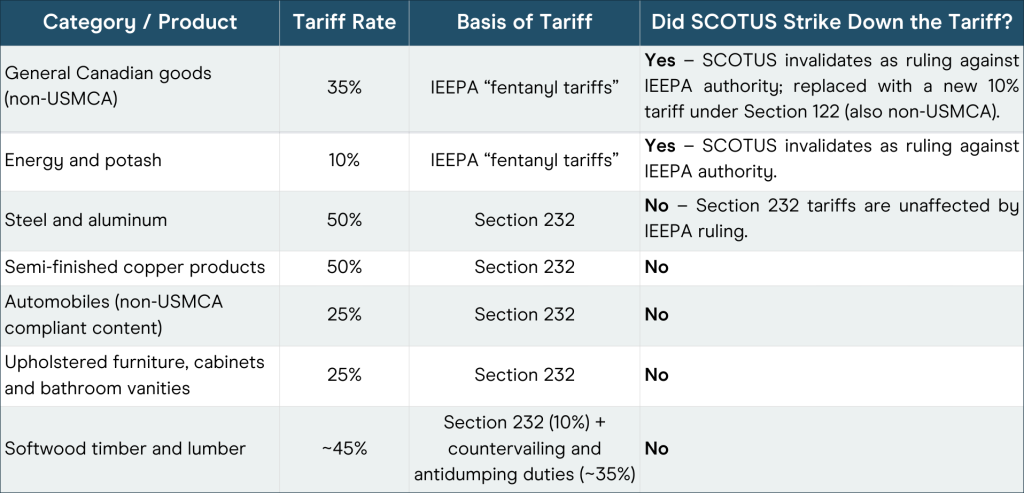
While IEEPA tariffs have been invalidated, the highest and most economically consequential tariffs facing Canada are rooted in Section 232, and those remain fully in force.
Trump’s IEEPA Replacement
Within 24 hours of the Supreme Court ruling, Trump moved to replace his IEEPA measures with a new 10% global tariff citing a different statute altogether: Section 122 of the Trade Act of 1974. This provision allows the president to impose a temporary import surcharge of up to 15% for a maximum of 150 days to address “large and serious” balance‑of‑payments problems. No prior president had used this authority, but it is explicitly tariff‑related and therefore less vulnerable to the constitutional critique that doomed the IEEPA measures.
For Canada, the Section 122 tariff preserves an exemption for exports that qualify as USMCA‑compliant. Energy and energy products are also fully exempt. While this new 10% tariff on non-CUSMA-compliant goods is time‑limited and narrower in legal scope, Trump has indicated that it is a transitional measure to more permanent tariffs. He has pointed to expanded use of Section 232 and the potential launch of investigations under Section 301 of the same 1974 Act, which governs retaliatory tariffs for unfair trade practices.
Why Section 232 Remains a Detriment
For Canada, the distinction between IEEPA and Section 232 is decisive. IEEPA tariffs applied broadly and could be unwound quickly by the courts. Section 232 tariffs, by contrast, are sector‑specific, justified on national security grounds, and politically resilient. Canada may dispute the national security rationale, but US courts have historically granted presidents wide deference under Section 232, making legal challenges unlikely to succeed.
Section 232 tariffs also sit uneasily but persistently alongside USMCA. While the agreement eliminated most baseline tariffs on qualifying goods, it also explicitly preserved national security exceptions. That carve‑out has become the pressure point through which Washington can exert leverage without formally breaching the treaty.
A Perilous Summer Ahead
Shifting US tariff policy is creating fresh uncertainty for Canada as the July review of USMCA approaches. Although the agreement’s built‑in review mechanism was originally designed to promote stability and continuity, it now provides the US delegation with a formal opportunity to reopen core terms of the agreement at a moment when tariff pressure is already being applied through domestic US law.
With Section 232 tariffs on Canada firmly intact, a newly imposed 10% tariff under separate authority (also USMCA duty-exempt), and additional sector‑specific tariffs under consideration, Canada finds itself with reduced leverage and limited legal recourse. To date, attention has largely centered on the risk that USMCA could be weakened through this expanded use of national‑security tariffs and more assertive US negotiating tactics.
However, a more serious risk looms alongside the review process. The agreement allows for a member to withdraw on six months’ notice at any time, and recent trade actions demonstrate a clear willingness by Trump to rely on domestic statutory authority even where it conflicts with existing trade commitments. If USMCA is no longer viewed as advancing US trade policy objectives, there is little to prevent its use as leverage or its abandonment altogether.
With roughly nine in ten Canadian shipments to the United States now claiming duty-free preferential treatment under USMCA, a US withdrawal and the subsequent loss of the agreement’s protections for compliant goods would deal a substantial blow to the Canadian economy. As the USMCA review approaches, Canada finds itself in a perilous position, facing not only the erosion of preferential access but the credible risk that the framework underpinning North American trade could be fundamentally altered, or undone, on relatively short notice.
Sources
Blakes. “U.S.–Canada Tariffs: Timeline of Key Dates and Documents.” March 2026.
Global Affairs Canada. “Softwood Lumber: Frequently Asked Questions.” Government of Canada. February 2026.
JD Supra. “Tariffs Redux: What Importers Should Know.” February 2026.
Norton Rose Fulbright. “U.S. Supreme Court Strikes Down IEEPA Tariffs, but Practical Impacts for Canadian Exporters Limited.” February 2026.
The White House. “Fact Sheet: President Trump Imposes Tariffs on Imports from Canada, Mexico, and China.” February 2025.
The White House. “Fact Sheet: President Trump Imposes a Temporary Import Duty to Address Fundamental Int’l Payment Problems.” February 2026.
The White House. “Imposing a Temporary Import Surcharge to Address Fundamental Int’l Payments Problems.” February 2026.