
For many affluent Canadian families, charitable giving ranks highly among their core long-term wealth objectives. Families with this objective often consider philanthropy within the broader context of purpose, responsibility, and continuity across generations, rather than as a series of isolated charitable contributions.
When philanthropy is part of a family’s wealth plan, the way in which they give becomes an important consideration. Different approaches carry different implications for governance, administration, and continuity, particularly where giving is intended to extend beyond a single generation.
In Canada, families typically structure charitable giving in one of three ways. Some give directly to registered charities, which is straightforward and works well for those that wish to make a simple annual donation. Others establish a private foundation, suitable for supporting a long-term philanthropic plan while also introducing formal governance, administration, and regulatory obligations. Increasingly, families are choosing Donor Advised Funds, which provide a structured yet flexible framework for giving over time without the operational burden of running a standalone foundation.
What Is a Donor Advised Fund (DAF)?
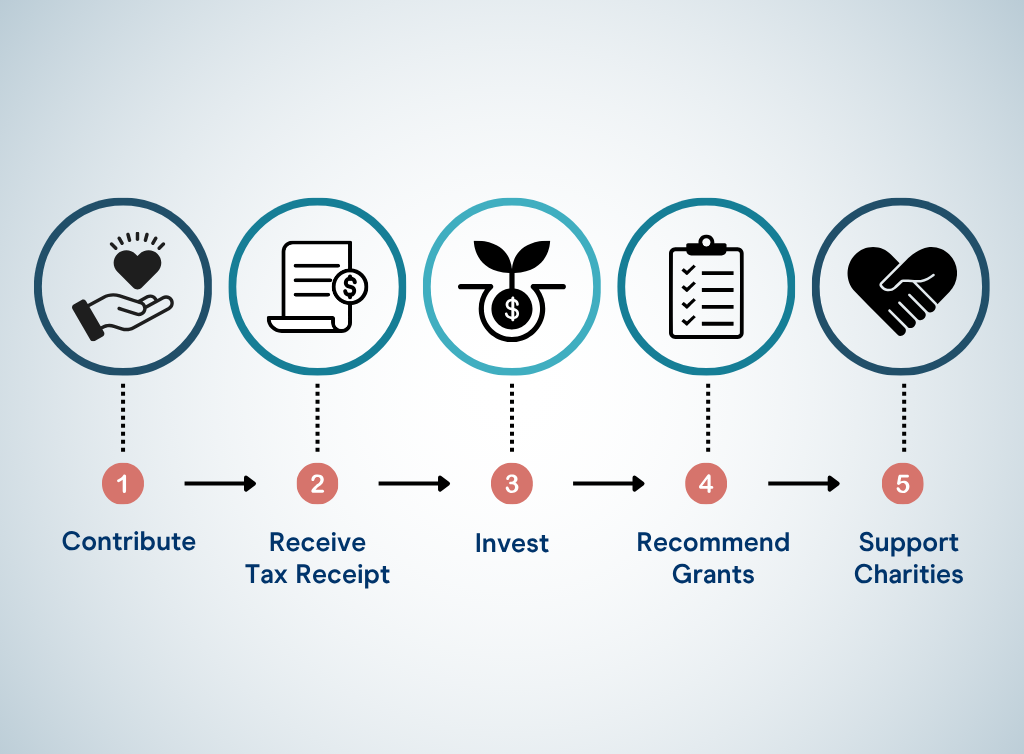
A DAF is a charitable investment account held on a family’s behalf by an established public charitable foundation. The donating family contributes cash, securities, or other eligible assets to the account and receives a charitable tax receipt in the year of the contribution. The family can then leverage the DAF’s infrastructure to direct grants to registered charities over time.
The sponsoring foundation handles the required administration to maintain charitable status and enable grant-making. The family retains an advisory role, determining how the assets are invested and directing when, where, and in what amounts grants are made. The foundation then facilitates those grants from the DAF following the family’s recommendations.
For families evaluating charitable giving options, the decision often comes down to structure and responsibility. In many cases, DAFs offer a compelling balance of flexibility, control, and administrative simplicity.
Why More Families Are Choosing DAFs
1. Ability to invest charitable capital on a tax-exempt basis
Assets contributed to a DAF can be invested and grown over time, much like any other investment account. Management of these assets remains with the family’s investment advisor or portfolio manager, allowing for the same rebalancing, strategic adjustments, and ongoing oversight regimen applied to the family’s wealth. The portfolio manager can also implement a tailored investment strategy designed specifically for the charitable account to best reflect the family’s philanthropic objectives and gifting horizon. Because the donated assets are legally held by sponsoring charitable foundation, income and capital gains earned inside a DAF are exempt from tax. With no tax drag on returns, the full value of investment growth compounds for future charitable use. This supports a longer gifting horizon, particularly for families seeking to involve multiple generations in the gifting plan and/or build a sustained giving program.
2. Flexible tax planning
A DAF allows families to separate the timing of a charitable contribution from the timing of charitable grants. Contributions can be made in years when tax planning considerations are most relevant, while grants can be distributed gradually over time. This flexibility can be particularly useful after a liquidity event, a business sale, or the realization of significant capital gains.
It also helps families avoid “rushed” giving decisions made solely to meet a calendar deadline, since DAFs are typically not subject to the annual minimum gifting requirements that apply to private foundations.
3. Simplified administration and reduced costs
The DAF sponsoring foundation handles the operational requirements that would otherwise fall on the donating family, including receipting, recordkeeping, disbursements, and regulatory reporting. This reduces the ongoing workload that can build up when giving is spread across multiple charities, especially when several family members are involved. It also avoids the need to create a governance process from scratch or manage annual filings and other administration obligations associated with a private foundation. Private foundations typically require accountants, annual information returns, and ongoing banking fees, all of which add cost and administrative effort. Significant scale is often required to make a private foundation viable over the long-term. A DAF provides a more streamlined way to organize charitable activity, with fewer administrative responsibilities for the family to manage directly.
4. Support for family involvement and continuity
DAFs can provide a practical way to involve children and grandchildren in charitable decisions, without requiring the formal board structure or governance obligations of a private foundation. Families can adopt a repeatable process for discussing causes, assessing organizations, and making grant recommendations, which supports shared values and long-term stewardship. Over time, younger family members can become more involved in these discussions and recommendations according to their own philanthropic interests. This approach can help sustain philanthropy across generations and can also provide continuity as family leadership evolves.
5. Clarity and consistency in giving
By centralizing charitable activity in a single account, a DAF makes it easier to track contributions, grants, and charitable themes over multiple years. Better tracking of charitable efforts may also help bring discipline to an area that can otherwise become reactive, driven by one-off requests or annual campaign cycles. Families often find that establishing a DAF leads to more intentional charitable giving and a clearer philanthropic vision.
6. Discretion and privacy
A DAF allows families to give anonymously if they choose, since grants are issued by the sponsoring foundation rather than directly by the donor. This can be valuable for families who prefer to keep their charitable activity private, whether to avoid unsolicited requests, manage public expectations, or simply reflect a personal preference for quiet generosity. By contrast, private foundations are subject to public disclosure requirements, including the filing of annual information returns to the CRA. For families who view discretion as an important part of their giving, the DAF structure offers a level of privacy that a foundation cannot typically match.
7. Easy to start up and wind down
Establishing a DAF is straightforward. A family completes a short onboarding process with the sponsoring foundation while the family’s portfolio manager coordinates the opening of an associated charitable investment account. The initial contribution can then be facilitated by their portfolio manager. No government filings by the family are needed, and the process can be completed quickly without the need to establish a new legal entity.
The exit process is equally efficient. Should a family choose to wind down their DAF, they can either grant the remaining capital to their chosen charities and close the account, or transfer the capital to another DAF or foundation aligned with their objectives.
Is a DAF Right for Your Family?
A thoughtful approach to family giving starts with clear intent, a repeatable process, and a structure that can endure as circumstances change. Whether a family gives directly, establishes a private foundation, or sets up a Donor Advised Fund, the approach should align with the family’s broader wealth objectives, involvement of the next generation, and willingness for administration.
We help families work through these decisions, coordinate with their other professionals, and implement a giving strategy that fits within each family’s overall wealth plan. If you are exploring your options for charitable giving or are interested in establishing a DAF, we would welcome a conversation. Get in touch with a portfolio manager at Tacita Capital here.